


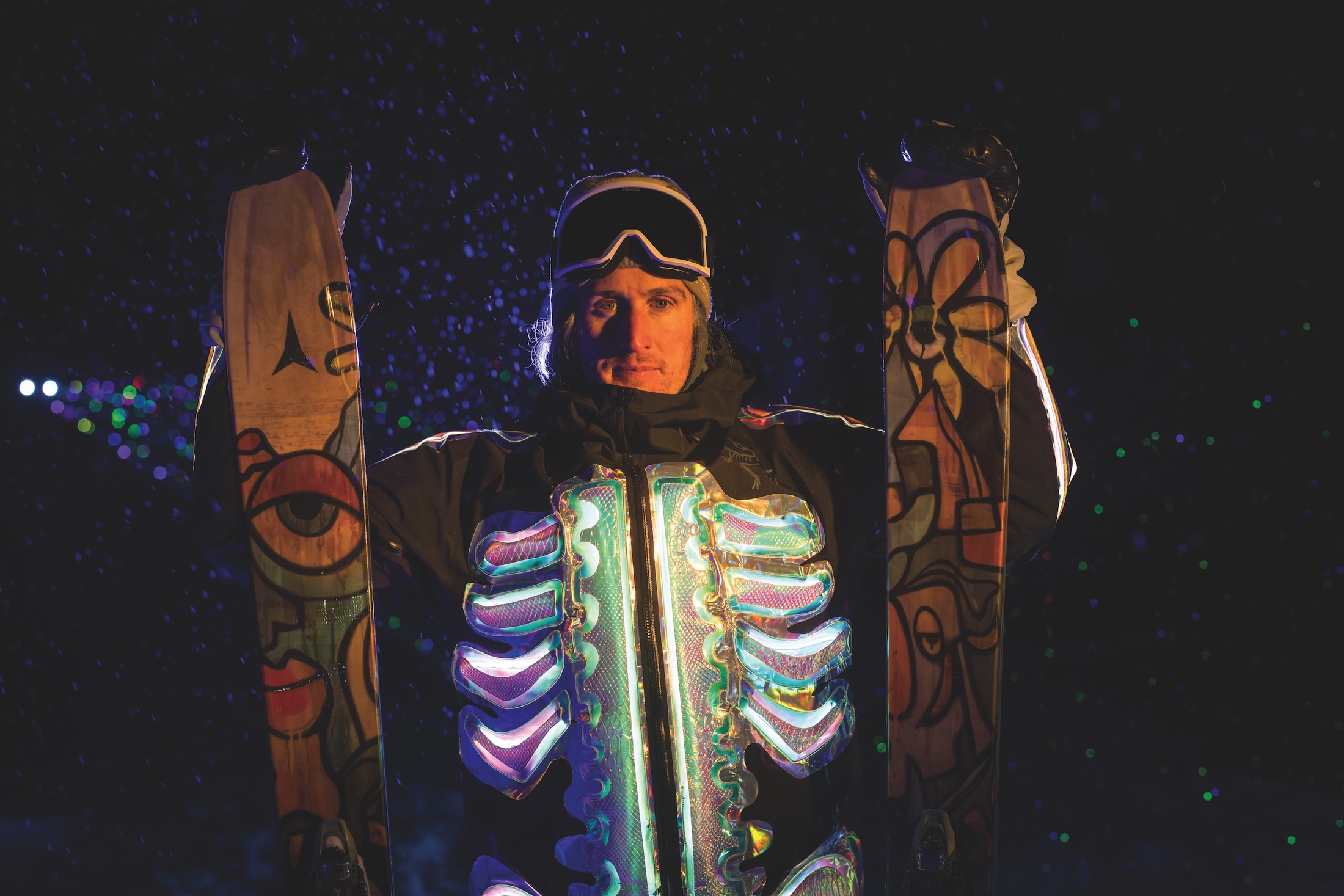
Chris Benchetler by Mike Wiegle.
Chris Benchetler, the art-world’s favorite pro skier and the ski-world’s favorite Deadhead, is back with Mountains of the Moon. His new film, which he calls his “opus”, shows how the Grateful Dead’s ethos is so much more than just music—it’s an entire way of seeing the universe.
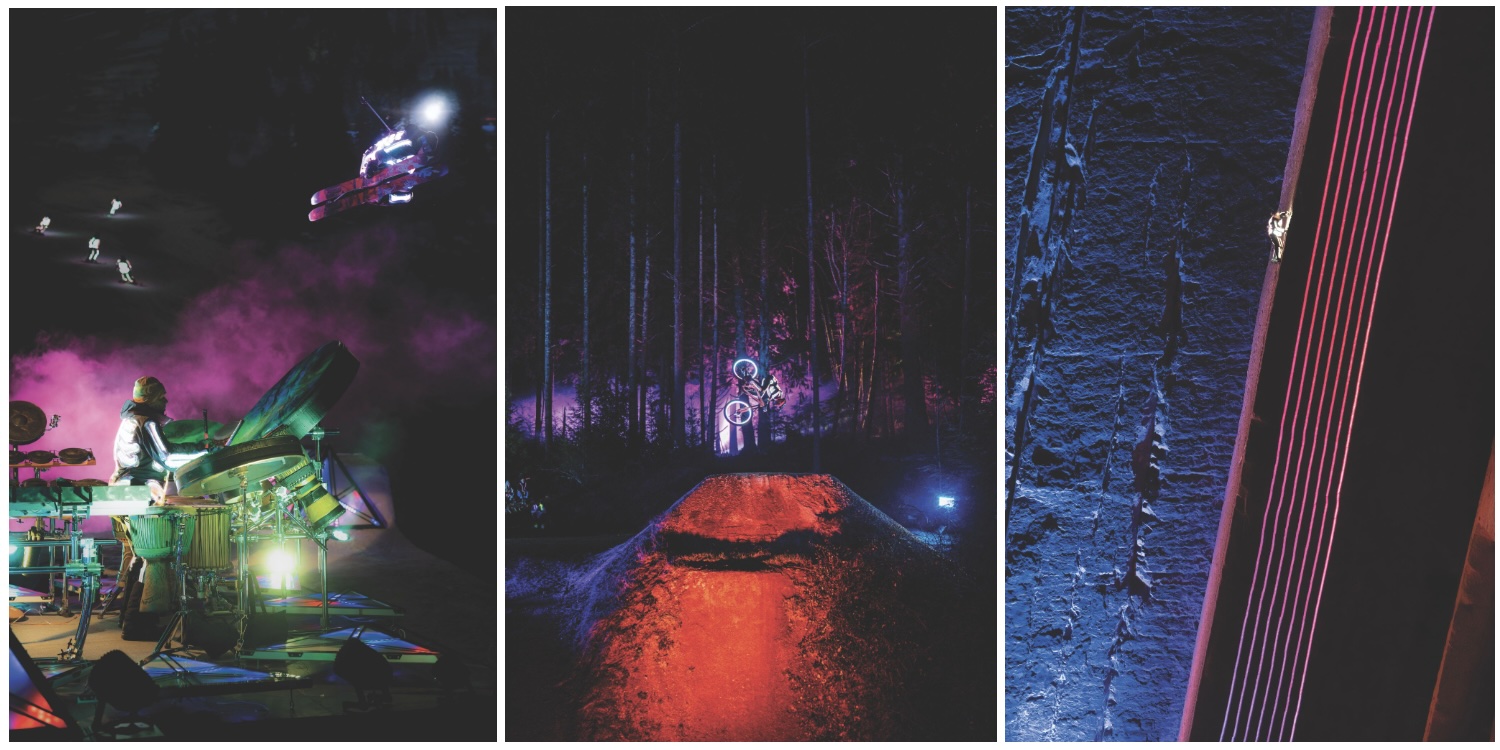
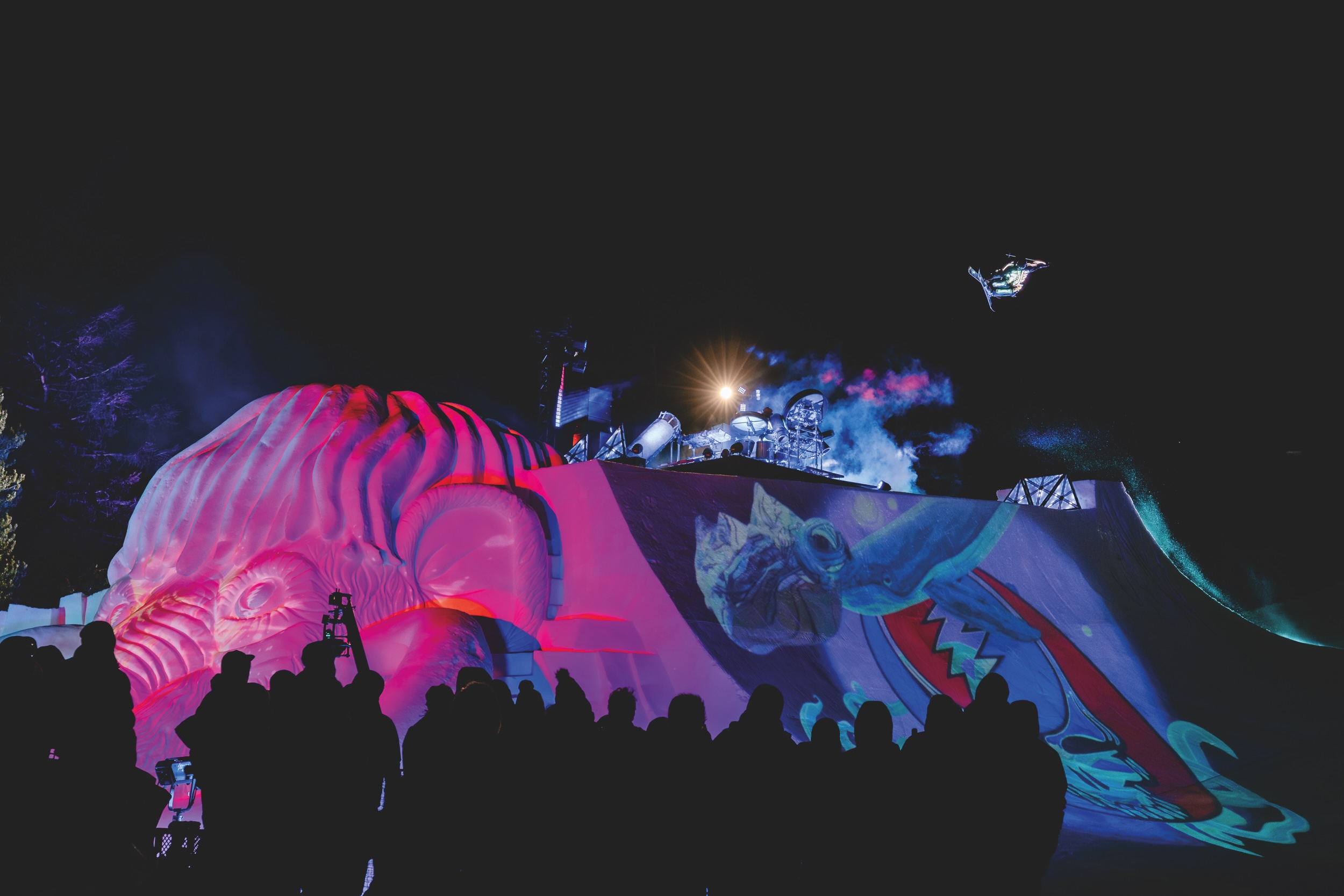
Imagine this: The mountain is black. Not grey-blue in the moonlight, but an absolute, primordial black. Then, a streak of electric-blue light arcs through the void, kicking up a plume of incandescent powder. Another line, this one hot pink, crosses it. The camera pulls back, and you see them: two skeletons, rippling with LED light, dancing down a 50-degree slope in perfect, synesthetic rhythm.
This is not a dream you had after a long, strange night on a headful of doses at the Sphere. This is the visual gospel of Chris Benchetler.
If you’re a skier, you know Benchetler. He’s the Mammoth Lakes-based ski pro whose fluid, surf-inspired style has defined a generation of big-mountain freeskiing, and whose signature Atomic ‘Bent’ ski line is wildly popular for its blend of performance and art. (Full disclosure: I bought a pair of Bent 100s myself a few years back after a 15-year ski hiatus. To this day, I keep them propped next to my desk at work, still mesmerized by Benchetler’s “old man winter-y” top sheet art and dreaming of the next day I can unglue myself from the computer and strap in. They are, in fact, amazing.) If you’re a Deadhead, you also know him as the artist behind those coveted Grateful Dead x Atomic skis, the ones adorned with dancing bears or his signature skeleton-and-rose motifs. If you’ve bought an Ikon or Epic pass the last couple of years, you’ve probably caught a glimpse of them in a lift line.
And if you’re in the Venn diagram overlap of those two tribes, you know him as the creator of 2019’s Fire on the Mountain, a 25-minute ski film that was less a sports edit and more a Drums > Space psychedelic sacrament. It featured a tribe of Benchetler’s fellow masters, including skier Michelle Parker, snowboarders Jeremy Jones, Kimmy Fasani, and Danny Davis, and surfing icon Rob Machado, all carving through landscapes of pure light and color, all set to a blistering Dead soundtrack and narrated by the patron saint of cosmic broadcasting himself, the late, great Bill Walton.
It was, as one of the film’s stars said, “iconic.”
Now, Benchetler is back with the feature-length follow-up, Mountains of the Moon. If Fire on the Mountain was a perfectly rolled joint, Mountains is the full, seven-day spiritual retreat with. It’s a sprawling, ambitious piece of art that Benchetler calls his “opus.” It’s also a film that almost broke him. The film, which drops its official teaser today (October 30, 2025), is set for a global premiere in Los Angeles on November 15, accompanied by a week-long immersive art gallery powered by Arc’teryx.
Watch the Mountains Of The Moon Trailer:
“This project, Mountains of the Moon, really is like my opus, if you will,” Benchetler says, his voice earnest and reflective. We’re speaking on Zoom just as he’s putting the final touches on the film, and he sounds like a man emerging from a three-year vision quest, which, it turns out, is not far from the truth. “It’s an extension of me and my existence in this life. It has everything that inspires me, and it has a piece of me sprinkled throughout the entire project.”
Painting with Skeletons
The visual anchor of this new film, like the last, is the night skiing. The aesthetic, which Benchetler first explored in Sweetgrass Productions’ 2014 film Afterglow, is about more than just looking “super cool.” For him, it’s a way to re-see the world. Captured using cutting-edge cinematography, lasers, animation, and projection mapping, it’s an attempt to “see the familiar in the unfamiliar,” he explains. “I personally have spent a vast majority of my life in these natural landscapes, and you do that at night, and you’re completely flipping it on its head.”
It allows him to become a painter in real-time. “Being able to control the sun as an action sports filmmaker… and paint these landscapes is art in itself,” he says. To pull it off, he assembled his own tribe of visual masters, including Director of Photography Tyler Hamlet, Producer Ali Meiners, and Editors Cody Carter and Sean Logan. “And then you take the athletes, which are the brushstrokes of the painting, and they’re doing what they do best.”
In the Grateful Dead’s world of symbols, the skeleton suits have a deeper meaning. The glowing suits aren’t just a nod to Dead iconography. They’re a core part of Benchetler’s personal artwork and philosophy. “I paint skeletons all the time, which represent people at their core, stripped of all of our differences,” he says. “I think they speak to the concept of revealing what lies beneath the surface… they’re kind of like representing life and death and the inevitability of death, and all the people I’ve lost to the mountain. So there’s really deep concepts in my work already.”
To understand Mountains of the Moon, you have to understand how the first film “chose” him. The Grateful Dead organization, not exactly known for collaborating with ski brands, reached out.
“The opportunity to create a ski with the Grateful Dead came across my desk,” he explains. “Then I, being the person I am, love their music, and I make ski films, and I make my own skis. And so it was just me seeing an opportunity to create something bigger than me… I just kept pulling on these threads, seeing where it. would lead me.”
That thread led him to pitch the Dead’s management with a concept that went far beyond merchandise. “I was like, I don’t want to just create a ski,” he explains. His idea was to create a “functional piece of art,” and then, crucially, use that art to make something even bigger.
“I want to ski on the ski,” he told them, “and create something beautiful with the ski that we’re creating.”
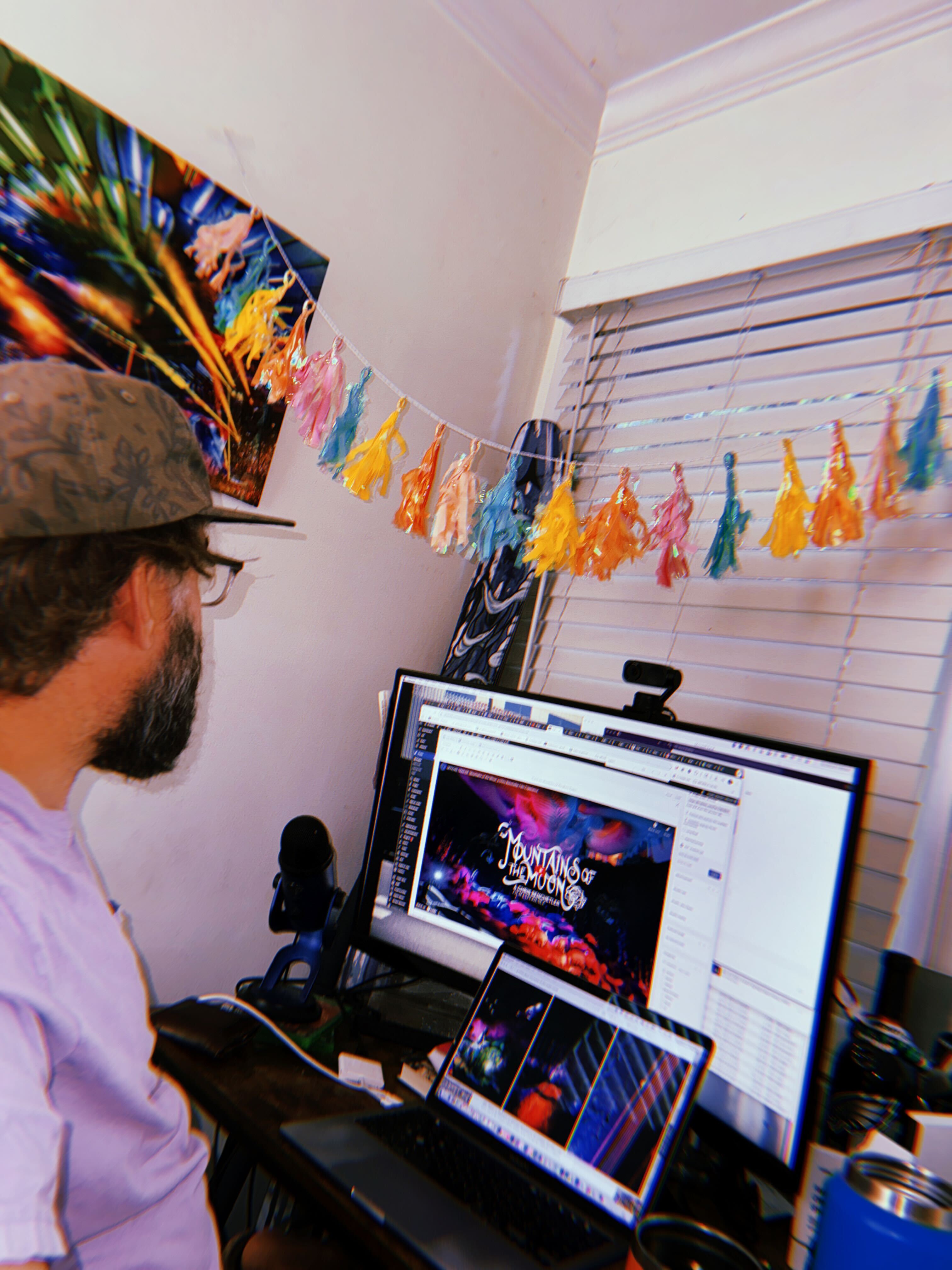
The author, BroBible Publisher Brandon Wenerd, at his desk with his Chris Benchetler-designed Atomic Bent 100 skis
Those “simple terms turned into a whole film.” But that film needed a voice. And the voice needed to represent both sport and music at the highest, most spiritual level.
There was only one option for Fire On The Mountain.
How Bill Walton Answered the Call
“That, of course, was Walton,” Benchetler says with a laugh. “And me being able to get to Bill Walton was just the universe doing its magic.”
The story is pure Deadhead kismet. Benchetler had done a 100-mile road bike ride with Walton years prior in Mammoth as “support crew.” He still had an email. He cold-emailed him the pitch. Walton, not recognizing the name, deleted it.
“But then his assistant happened to have my skis, similar to yourself,” Benchetler recalls. “And so his assistant brought it back out of his deleted folder, told him to reread it. So then he called Mark Pincus, who’s the president of Rhino Records… and he also called David Lemieux, who’s the legacy manager… just to see if I was legitimately doing something with the Grateful Dead.”
The word came back: He’s legit.
“I just got a random phone call from Bill that turned into an hour to two-hour conversation about passion and life and sport and all the things,” he says. “We built a beautiful friendship, and that kept evolving.”
That friendship became the beating heart of Fire on the Mountain. When it came time to write the script, Benchetler and a team of writers took a crack. Then Bill wrote his own.
“He knows every lyric and everything better than some of the band members themselves,” Benchetler says, still in awe. “He spoke in Grateful Dead lyrics… He saw the film before he wrote his version, and he just mixed and matched on his own.” The result was pure, uncut Walton: a poetic, hyperbolic, joyous sermon on fire, mountains, and cosmic flow.
The Opus Becomes a Crucible
Fire on the Mountain was a sensation. But for Benchetler, it was just the beginning. “That film left so much on the table,” he says. “Ever since that one ended, I was like, ‘Okay, I need to do this bigger and better.’ We learned so much. We have so many more people and resources.”
He began planning his opus. And then, “life happened.” What Benchetler glides past with that simple phrase is, in itself, a staggering epic of survival. His wife, the professional snowboarding icon Kimmy Fasani (who also appeared in Fire on the Mountain), was diagnosed with aggressive Stage 3 breast cancer in late 2021, just nine months after the birth of their second son, Zeppelin.
As Benchetler began building his Mountains of the Moon concept, he was simultaneously supporting Fasani through a grueling 10-month battle of chemotherapy, a double mastectomy, and radiation, all while co-parenting two very young children. Incredibly, they were also filming another documentary during this time, Butterfly in a Blizzard, which chronicled Fasani’s own journey.
The new project became a crucible. The challenges weren’t just logistical; they were personal, existential. “We had every reason and every hurdle imaginable for me to just face plant and give up,” he admits. “Every part of my life has suffered from this project… it was so intense. My wife showed up in such a huge way, picking up the slack with my family and my kids. Like, I was just… I was so immersed… I am a crazy artist, and I like this shit. Is that important to me that I will, I will sacrifice health and everything to make something I truly believe in.”
Mickey Hart + Drums > Space > Sphere
Those deep concepts attracted another member of the Dead’s inner circle: drummer Mickey Hart.
“Mickey was a huge fan of what we did for Fire on the Mountain,” Benchetler says. “He came to my world premiere in New York… he’s an artist himself, and he was always the one that appreciated it the most, I would say, because he’s very out there with his thinking, very similar to me.”
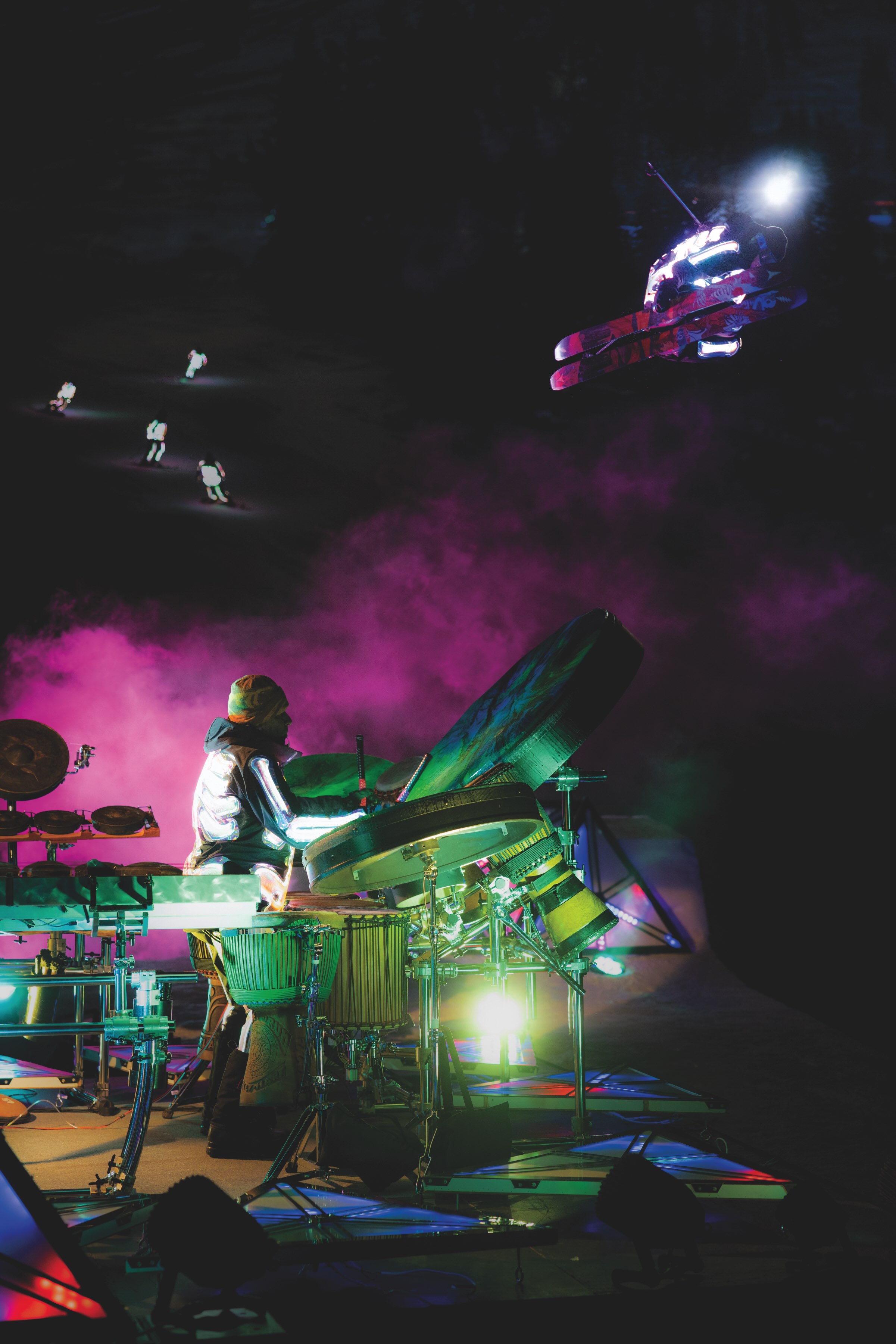
When Dead & Company announced their “Final Tour” in 2023, Hart hit up Benchetler. “Mickey hit me up and said, ‘I would like to use footage from the night stuff… for Drums and Space, I want to use some night footage.'”
Benchetler told him he was already planning to “turn the lights back on” for the new film. Then came the Sphere.
Benchetler, ever the artist, called Mickey. “I’m like, ‘What’s your plan for the Sphere? I have this concept about your rhythm being the pulse, or the heartbeat, that turns the lights back on… Do you have a plan for the residency?'”
What followed was a massive, parallel production. Benchetler brought Hart to Mammoth, built “this huge ice sculpture stage for him to play drums on,” and had skiers and snowboarders jump over him. The Sphere’s high-tech camera team came out, but their gear struggled in the cold and low light. So Benchetler’s Mountains of the Moon footage, mixed live by the visual wizards at Treatment Studio, became the psychedelic, kaleidoscopic backdrop for “Drums” every night at the Sphere.
“There was actually nothing ever from Fire on the Mountain in the Sphere,” Benchetler clarifies. “It was all new, created stuff… Every time Mickey hit a drum, things were reacting and changing and building… all of that shit was happening different every show.”
The collaboration went even deeper. For Mountains of the Moon, Benchetler sent Hart a “Drums and Space” segment from an old ’80s show in Egypt. “He’s like, ‘Nope, I need… I need to touch this sonically.’ So he completely scored a whole new drums track. Like… what? In what world am I going to make a film where Mickey Hart’s going to score a track for us? Like, that’s up here,” he says, his voice thick with disbelief. “All these things that have happened around this project… is in a world beyond words.”
“The music of the Grateful Dead has always been about exploration – of sound, spirit, and the unknown,” Mickey Hart said in a statement about the film. “Mountains of the Moon taps into that same energy, pushing creative boundaries to illuminate the deep connection between art, nature, and human expression.”
Enter the Mycologist
With Walton’s passing, the new film needed a new narrator. Benchetler found the only person alive who could match Walton’s cosmic significance in a totally different dimension: famed mycologist Paul Stamets.
The man is a legend in the psychedelic and wellness worlds, known for his foundational books, his appearance on The Joe Rogan Experience, and his starring role in the Netflix documentary Fantastic Fungi.
“He’s changed my life,” Benchetler says flatly. “His studies on mushrooms and how much he’s dedicated to the world of mycology and healing brains and cancer, and everything that he’s done, changed my life. And it did like a decade ago.”
Through the same universal magic that connected him to Walton, Benchetler met Stamets. “He happens to be a huge Deadhead. Go figure,” he laughs. “That side of Paul’s science and education, and the fact that he said yes and was passionate about this project in the same way that Bill was… that is huge.”
Stamets’s involvement is the key that unlocks the film’s true purpose. The film transcends the boundaries of a traditional ski or action sports movie, featuring masters of climbing, biking, surfing, and free diving, including fellow skier Michelle Parker, surfer Rob Machado, and mountain biker Carson Storch. It instead serves as a visual metaphor for the mycelial network—the interconnectedness of all things. That deep, thrumming, blissful feeling of dropping into a perfect powder line or losing yourself in the crescendoing deep-space vortex of a 30-minute “Dark Star”—Benchetler argues they come from the same source.
“All of those sports have shaped me as a human,” Benchetler says. “It’s far more important for me to highlight the masters of those individual sports… Us as athletes are riding the pulse of the universe. And that’s kind of going back to the whole rhythm and Mickey and music… tapping into something much bigger here. How this whole planet is working, how trees are breathing… everything Paul believes in, how everything is connected on a mycelium level, like all of that is encapsulated in the film.”
The film’s structure mirrors this philosophy. “The whole film starts at sunset,” he reveals. “We go through this whole avalanche sequence that represents the Big Bang, and we go into the darkness… We go through the seasons. We go through the cycle of life, plant, animals, ecosystem, all of that. And we come out at sunrise on the river… We tried to capture the entire ecosystem, the cycle of water.”

Rob Machado and Chris Benchetler photographed for Fire on the Mountain 2 at the Surf Ranch in Lemoore, CA
The Licorice Test
It’s a staggering amount of weight to put on one film. Benchetler knows it. He also knows that, like the Dead’s music, it’s not for everyone. “I don’t really care what people think about it,” he says, not with arrogance, but with the understated conviction of an artist who has bled for the work. “I’m not creating this for anyone other than myself… The Dead in general, people love it, people hate it.” It’s like licorice, I quip, echoing Jerry Garcia’s famous analogy for the band. “It is what it is,” Benchetler agrees.
So, I ask him, after all this, what is the one “heavy” thing he wants people to walk away with? What is the ethos of Mountains of the Moon?
He pauses, searches. “That’s a good question,” he says finally, not as a deflection but as a genuine admission. “I guess I should know this answer off the top of my head… I would say, I want them to feel something. I want them to feel inspired. I want there to be a sense of community. I want for them to recognize the importance of culture and art… In this day and age, our world is wildly complex in the worst ways and the best ways, right? And so I just think, as an artist, I just I hope how I’m able to express myself… that it leaves an impact on people. I hope, you know, the people that do love it, love it, the people that hate it, hate it… that polarizing side of it is important to me, too. Like I want art to be an important part of my ecosystem and my community and my culture.”
Another Thread in the Braid
There’s little doubt it will. The kid from Bishop who grew up in the mountains that US 395 bisects, a multi-modal artist who went from Eastern Sierra legend to global icon, who just wanted to make a beautiful ski, has become an unlikely, but essential, part of the Grateful Dead’s sprawling, collective grasp on a certain kind of seeker’s collective imagination, the kind that’s “bound to cover just a little more ground.” The film is just one component of the larger project, which also includes a forthcoming book of Benchetler’s photographs and art, as well as a deep commitment to sustainability through partners like A New Earth Project.
Benchetler has been talking to David Lemieux, the band’s official archivist and legacy manager, about the new project.
“To hear him say that my first film, and that what I’ve created and continue to create, is becoming… is part of their legacy, was like the most humbling statement I’ve ever heard,” Benchetler says, his voice quiet. “He sees people as… a skier himself, may not know about the music… but they’ve seen the Dead ski movie. It’s like, there are multiple topics. It’s like, ‘Did you go to the Sphere? Did you do this? Have you seen Fire on the Mountain?’ That topic is high on the list.”
He’s a part of the ecosystem now. Another thread in the great, golden braid, woven in the wind.
Chris Benchetler just kept pulling, and it led him all the way to the moon.