


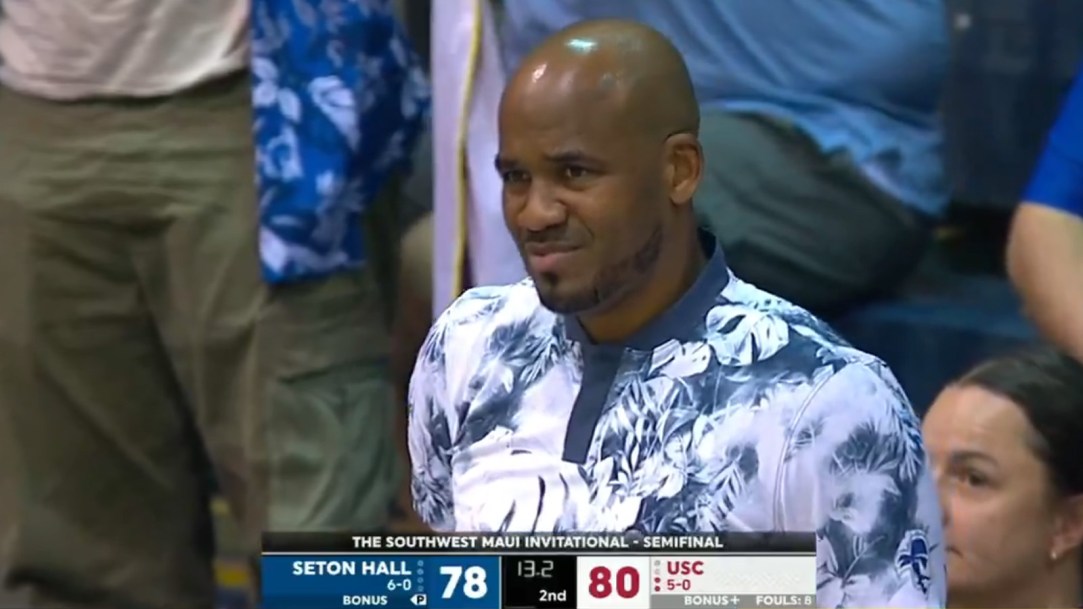
Seton Hall had an opportunity to take the lead with less than 15 seconds remaining in its college basketball game against USC at the Maui Invitational. However, the referees blew an important call and the Pirates were unable to use their challenge.
It was the first game-changing outcome to stem from the sport’s new rule.
This kind of thing would not be an issue for college basketball in the past. There still would have been a controversy over the blown call but the challenge did not previously exist.
USC beat Seton Hall by the skin of its teeth.
Seton Hall was picked to finish dead last in the Big East this season by pretty much everybody. Nobody thought the Pirates were going to be any good. Nobody.
Head coach Shaheen Holloway, who you might remember from St. Peter’s miraculous run during March Madness, is a phenomenal coach. However, he is forced to build a roster with one of the worst NIL budgets on the high-major level of the sport and he lost pretty much every player from last year’s team, which finished 2-18 in the conference and 7-25.
And yet, Seton Hall still managed to start the year at 6-0 with an 11-point win over No. 23 N.C. State on Monday to advance through the winner’s bracket to the semifinal round at the Maui Invitational.
USC, its opponent on Tuesday night, has a lucrative NIL budget on which to build. The Trojans expect to be an NCAA Tournament team after spending big money to land Ridney Rice and Chad Baker-Mazara, as well as UNC Asheville transfer Jordan Marsh and five-star freshman Alijah Arenas.
All of this goes to say that the Tuesday night game from the Lahaina Civic Center should’ve been a blowout. USC, according to Las Vegas, was supposed to win by at least 7.5 points.
The Trojans barely hung on to beat the Pirates by three, 83-81.
The new coach’s challenge rule sparked a college basketball controversy.
Seton Hall trailed USC by two points with just 13.2 seconds remaining in the second half when a loose ball went out of bounds on the baseline. The ball very clearly hit off of a Trojan last.
However, the officials ruled against the Pirates and gave possession to their opponents instead.
First game-changing example of the new challenge rule.
— Brian Rauf (@brauf33) November 26, 2025
Seton Hall used its challenge earlier in the game and lost, so it couldn’t challenge this call.
Ball went off USC and would’ve given the Pirates the ball with the chance to take the lead pic.twitter.com/4OfvLiLu4L
Shaheen Holloway would’ve liked to have used his coach’s challenge. College basketball drew inspiration from the NBA to adopt a new rule during the offseason to improve the flow of the game.
“Under the coach’s challenge rule, teams must have a timeout to request an instant replay review challenge.
“If the instant replay review challenge is successful, teams will be allowed to have one additional video review challenge for the rest of the game, including overtime.
“If the first video review challenge is unsuccessful, the team loses the ability to challenge the rest of the game.
“Officials can initiate video reviews on basket interference/goaltending and restricted arc plays in the last two minutes of the game and into overtime. Recent data shows these reviews caused minimal game interruptions. NCAA Men’s Basketball Rules Committee members think the coach’s challenge will have a significant impact on the flow of the game. Officials cannot conduct video review on out-of-bounds calls unless through a coach’s challenge.”
— NCAA Rulebook for 2025-26
Pay close attention to the last sentence. Officials cannot conduct video review on out-of-bounds calls unless through a coach’s challenge.
Thus, Holloway would’ve had to use his coach’s challenge to review the play on the baseline that was wrongly ruled for USC. Except he couldn’t.
To use the challenge, the team must still have at least one timeout remaining. Seton Hall did not. Holloway could not use his challenge. The Trojans wrongly received possession and went on to win.