


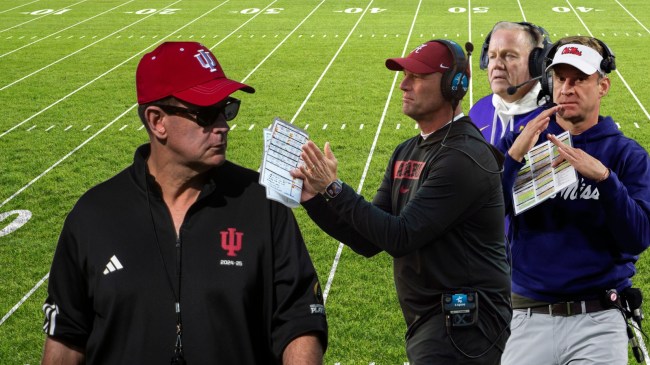
iStockphoto / © Rich Janzaruk/Herald-Times / USA TODAY NETWORK via Imagn Images / © Corey Perrine/Florida Times-Union / USA TODAY NETWORK via Imagn Images / © Jake Crandall/ Advertiser / USA TODAY NETWORK via Imagn Images / © Stephen Lew-Imagn Images
The College Football Playoff will weigh strength of schedule more heavily moving forward the selection committee announced days before the 2025 season opener. That could be bad news for programs cancelling future games vs. P4 opponents.
The Indiana Hoosiers might be most impacted by the change. They’ll have to be close to perfect in order to receive postseason consideration.
Scheduling has been a college football talking point throughout the offseason following the conclusion of the first ever 12-team playoff field. Much of the discussion centered around the SEC.
College Football Playoff caves to SEC demands.
Three 9-3 teams were left out of the postseason field in Alabama, Ole Miss, and South Carolina. Each boasted a strength of schedule in the nation’s Top 8.
Those spots were filled by Indiana and SMU, who failed to win their conferences. The Mustangs ranked 41st according to Team Rankings in schedule strength ahead of the CFP. The Hoosiers were 42nd.
Indiana, in particular, was a target for upset SEC fans. The program played just two teams that had a winning record in the regular season, going 1-1 in those matchups. It lost its only game vs. a ranked opponent by three scores.
The Hoosiers were swiftly dropped by Notre Dame in the opening round of the playoff. SEC fans demanded a change to the selection criteria.
Indiana did go 11-1. Wins matter. Both Alabama and Ole Miss lost games they shouldn’t have, which kept them out of the CFP field. Still, all three of those SEC candidates boasted several wins far better than IU’s top victory against 7-5 Michigan.
Curt Cignetti stirred the pot after receiving criticism.
The Indiana head coach mocked the SEC over the scheduling complaints. “We figured we’d adopt an SEC scheduling philosophy.”
That outlook involved cancelling future contests with the likes of Louisville and Virginia in order to add weaker foes.
The Hoosiers will play 15 non-conference games over the next five years. None will be on the road. None will involve a P4 opponent. Five will be against FCS teams.
There is reasoning behind the approach. It revolves around the Big Ten’s conference setup.
“We play nine Big Ten Conference games, which is more than most other conferences,” Cignetti said. The SEC plays just eight league matchups, as does the ACC.
It provides the opportunity for four non-conference games compared to three for Big Ten members, which can theoretically create an opening for an extra “gimme” game for Southeastern Conference teams.
Is Cignetti’s take completely factual? In some cases, yes. In others, no.
The SEC requires one non-conference game to feature a P4 school to “even” the playing field. Many SEC members play multiple power opponents outside the league.
Both the Big Ten and SEC play inferior opponents. One league typically schedules them in September while the other opts for November.
In any case, every major school in the country plays at least nine P4 foes. Anything more is an added challenge, which Indiana is avoiding.
Indiana’s approach worked in ’24. It might not moving forward.
The Hoosiers caught the perfect storm in 2024. They played an extremely favorable conference slate, missing out on Oregon and Penn State.
They removed Louisville from the schedule to ensure there were three non-power opponents out of conference.
Indiana was rewarded for its 11 wins, many of which came in dominant fashion. It was not penalized for a lacking strength of schedule, losing its headline game, and failing to make a conference title appearance.
That could change moving forward. The College Football Playoff is weighing the strength of opponents more heavily.
The College Football Playoff selection committee announces the changes to its strength of schedule metric. pic.twitter.com/POIeJ0wMwe
— Brandon Marcello (@bmarcello) August 20, 2025
“This metric rewards teams defeating high-quality opponents while minimizing the penalty for losing to such teams. Conversely, these changes will provide minimal reward for defeating a lower-quality opponent while imposing a greater penalty for losing to such teams.”
With Indiana removing as many notable non-conference matchups as possible, the potential for big wins decreases. It will make the need to be perfect all the more important.
The Hoosiers were able to do so last season. Still, they had three-loss SEC teams nipping at their heels in the selection process.
They may not get the benefit of the doubt the next time around. An omission would be a product of their own doing.