


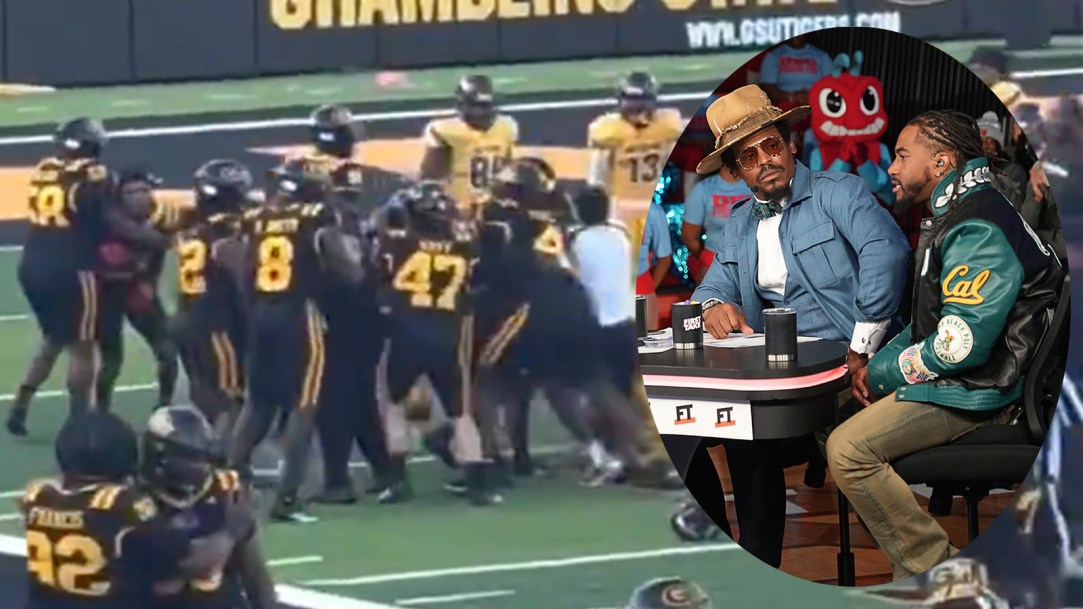
DeSean Jackson and Cam Newton did not think highly of the brawl that broke out at the college football game between Grambling State and Bethune-Cookman. They both called for accountability.
However, their reactions were met with mixed reactions.
Some college football fans believe these two former NFL players are right on point with their opinion. Others question why HBCU and PWI programs are held to different standards.
A nasty brawl spoiled the college football game between Grambling State and Bethune-Cookman.
The aforementioned incident took place just after halftime on Saturday. A select group of Wildcats allegedly hung around the locker room tunnel a little bit longer than the Tigers would like, which led the latter to confront the former. What started as some pushing and shoving very quickly turned ugly.
Haymakers started flying as an all-out melee ensued. It was violent.
Grambling head coach Mickey Joseph initially blamed Bethune-Cookman for starting the altercation. He ensured his program would not tolerate disrespect and stood behind his players and their actions.
Joseph later apologized for his comments during a prepared statement to condemn violence. The SWAC issued a suspension for 27 players in total — 18 Tigers, nine Wildcats. Both schools also received fines.
Cam Newton called for Mickey Joseph to be fired.
Although Newton himself did not play for an HBCU, he has direct ties to the culture. His little brother played at Howard and he often attends various Homecoming events across the country.
First Take also visits an HBCU campus a few times per year. In fact, Newton recently got into a physical altercation with the mascot at Alabama State, which adds an element of irony to his latest “hot take.”
Better than any skit 🤣🤣🤣🤣🤣
— Nick Eden (@NickEden) October 24, 2025
Cam Newton said it’s bitch slap a Bulldog day 🤣🤣🤣🤣 pic.twitter.com/yjz1veHLkt
Cam Newton addressed the brawl between Grambling State and Bethune-Cookman on his podcast, 4th & 1. He called for Joseph to be removed from his role as head coach for his response to the incident.
“I will not B.S. with this, this is a firing offense because them your players. I don’t care what somebody else did, it’s what you do. In retaliation. I’m going speak on how I feel. I know right from wrong, and that Grambling State and Bethune-Cookman… was wrong.”
Newton also claimed the brawl “set us back.” The word “us” refers to “blackness and Black culture.”
Cam Newton breaks down why Grambling State's head coach response to the HBCU brawl was a FIRABLE OFFENSE… and what's at stake when networks are watching.
— 4th&1 with Cam Newton (@4thand1show) November 12, 2025
New Hot Take out now!
📺: https://t.co/f3xZ7G8QRE pic.twitter.com/1Wq1rTOCOA
He was not the only person to express these kinds of thoughts.
DeSean Jackson used the word “ghetto.”
Jackson currently serves as the head football coach at Delaware State. Delaware State is an HBCU.
When asked for his opinion on the brawl, DeSean Jackson echoed Newton’s thoughts on how it hurts the image of these programs. Not just Bethune-Cookman and Grambling State. All HBCUs.
“It just shows how ghetto we can look sometimes, man, and it don’t look good,” he said. “When we talk about Power Five opportunities, situations like that hurt us. When people look down on the HBCUs and see things like that, it stunts our progress and the steps we’re trying to take to the next level.”
He hopes the melee will serve as a lesson.
.@DeSeanJackson10 reacts to Grambling / Bethune Cookman BRAWL 😳 pic.twitter.com/jHCnOU3B9A
— House of Action (@HouseofAction_) November 12, 2025
Jackson wants HBCU programs to achieve national recognition and respect. These kinds of incidents make it harder to reach that goal.
College football fans are split on the discussion of HBCU programs.
On one end of the conversation, supporters of Jackson and Newton agree. The lack of accountability in direct response to the brawl did not present HBCUs in a positive light. They see the challenge these programs face to get the respect they deserve and question how a brawl helps to advance that narrative. They also see how Joseph’s initial comments seemed as though he condones violence, which discredits his eventual apology.
On the other side of the conversation, critics question why Jackson would use the word “ghetto.” They believe his remarks lack empathy and context. They also point to something of a double standard.
Fights happen everywhere in college football. Not just at HBCUs. When PWI programs are involved, it only reflects on the schools involved. When HBCU programs are involved, it reflects on all HBCUs.
This fight between Grambling State and Bethune-Cookman exemplifies the need for balance. Accountability must be at the forefront of internal critique. The image of these historic institutions must also be protected. There needs to be a middle ground.