


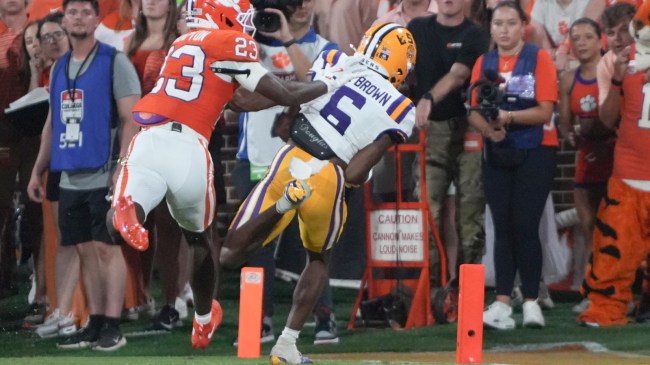
© Ken Ruinard / USA Today Network South Carolina / USA TODAY NETWORK via Imagn Images
What is a catch in college football? It was a question being asked by a number of viewers on the season’s opening weekend.
Multiple instances led to criticism following overturned calls in crucial situations. Video evidence proves referees actually have no clue how to interpret the rule.
A catch is defined as follows according to the rulebook:
(A) To catch a ball means that a player:
- Secures control of a live ball in flight before the ball touches the ground, and
- Touches the ground in bounds with any part of his body, and then
- Maintains control of the ball long enough to enable him to perform an act common to the game, i.e., long enough to pitch or hand the ball, advance it, avoid or ward off an opponent, etc.
(B) If a player goes to the ground in the act of catching a pass (with or without contact by an opponent) he must maintain complete and continuous control of the ball throughout the process of contacting the ground, whether in the field of play or in the end zone. This is also required for a player attempting to make a catch at the sideline and going to the ground out of bounds. If he loses control of the ball which then touches the ground before he regains control, it is not a catch. If he regains control inbounds prior to the ball touching the ground it is a catch.
(C) If the player loses control of the ball while simultaneously touching the ground with any part of his body, or if there is doubt that the acts were simultaneous, it is not a catch. If a player has control of the ball, a slight movement of the ball, even if it touches the ground, will not be considered loss of possession; he must lose control of the ball in order for there to be a loss of possession.
(D) If the ball touches the ground after the player secures control and continues to maintain control, and the elements above are satisfied, it is a catch.
What is a catch in college football?
The elements above need to be satisfied in order for a catch to be made. The main point of contention this weekend applied to the “surviving the ground” aspect of the rule.
There is also the added nuance of “making a football move.”
LSU was victim of an overturned touchdown call in a close road game vs. Clemson on Saturday. Barion Brown appeared to successfully secure a Garrett Nussmeier pass in the endzone.
It was initially ruled a catch. That decision was changed after video replay.
Now that the dust has settled, let’s talk about the Barion Brown catch that was called back pic.twitter.com/FQIPWNQvQH
— Boppa 🧟♂️ (@ihatebbls) August 31, 2025
Brown made a one-handed grab, gained possession, and crossed the goal line. The ball moved when he made contact with the ground.
Everyone in the booth thought it was a touchdown. Officials disagreed.
The touchdown was wiped out. LSU later missed a field goal in the eventual 17-10 victory.
The following day, the college football catch rule was again a talking point, this time in a game between South Carolina and Virginia Tech.
Nyck Harbor appeared to nab a touchdown score for the Gamecocks. He grabbed a LaNorris Sellers pass over an outstretched defender, took three steps with possession, and landed out of bounds.
Just as he hit the ground, the defender made contact with the football to briefly jar it loose. Again, it was initially ruled a catch. Again, it was overturned.
We’re actually not calling this a catch?
First Barion Brown in the LSU game, now Nyck Harbor in the South Carolina game, man these overturns are just bad.pic.twitter.com/7JpCdJkJpE
— Sam Wagman (@swagman95) August 31, 2025
In both instances, the ball moved as players went to the ground after multiple steps with the football.
An argument could be made based on previous data that football moves were made and that possession was maintained long enough to grant a catch.
Video evidence contradicts the catch rulings.
Interestingly enough, a game between LSU and South Carolina from last season showed past precedent on the “surviving the ground” aspect.
The Tigers made a crucial catch on the sidelines during a 36-33 win. It was originally called incomplete as the ball came loose when the receiver made contact with the ground.
It was overturned to give LSU a first down near the goal line just before the go-ahead score.
So this was a catch last year? Maybe I really just don’t know what a catch is (Gamecock viewer discretion advised) pic.twitter.com/7JC1MA0t6a
— Wes Mitchell (@WesMitchellGC) September 2, 2025
“The receiver had possession with two feet on the ground prior to contact by the defense,” was the reasoning behind granting the catch. No mention of surviving the ground or a football move. Just two feet inbounds.
There was no difference in that play than the previous two mentioned.
The most head scratching part of this situation is not the ruling alone. It’s that all three very similar plays were overturned using video replay, with multiple outcomes.
Referees admitted not only that the original call was borderline, but that there was enough evidence to definitively rule one way or another.
The rule is not the issue. Consistency with how it’s interpreted is. It’s probably time to take a step back from video replay and the never-ending list of requirements that must be met.
If it looks like a catch, it’s probably a catch.